
Acoustic panels
Six panel types, each made to the sizes and finishes your room plan calls for.
Plan my room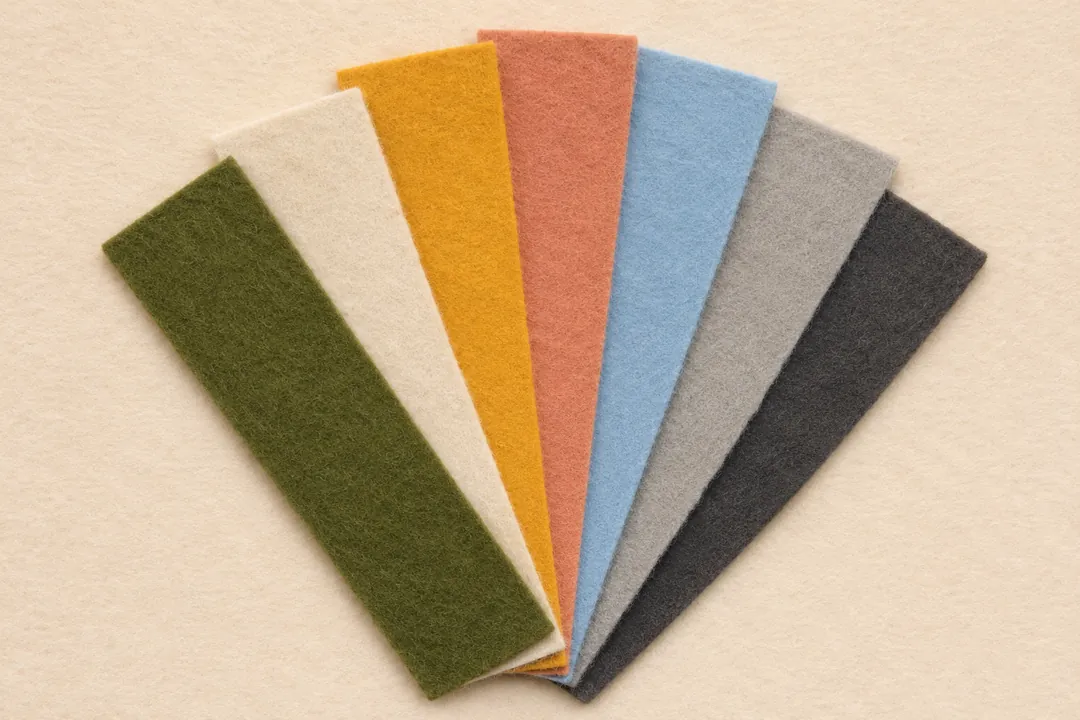
- Panel types
- Wall, cloud, baffle, printed art, felt and wood slat
- Sizes
- Made to your plan rather than picked from a catalog
- Performance data
- Source test reports named in every proposal
Fabric-wrapped wall panels
An absorptive core wrapped in fabric, sized and colored for your walls.
Ceiling clouds
Flat absorptive panels hung below a hard ceiling, over the people talking.
Ceiling baffles
Vertical blades hung in rows, for high, open or crowded ceilings.
Printed art panels
Your artwork or photography, printed on a panel that absorbs sound.
Felt panels
Solid-color polyester felt, cut into panels, tiles and shapes.
Wood slat panels
Wood or veneer slats over acoustic felt, for rooms that want timber.
Every panel we make does the same job: it gives sound a soft, porous surface to sink into instead of a hard one to bounce off. The six types differ in where they go, how they look and how much of the room they take up. Your panel plan settles the choice, but the reasoning usually runs in this order.
How to choose
- The surface you can spare. Free wall at seated or standing ear height suits fabric-wrapped wall panels, felt panels or wood slat panels. If the walls are glass, shelving or windows, look up: ceiling clouds hang flat below the ceiling and ceiling baffles hang on edge in rows.
- The ceiling height. Clouds suit ordinary ceilings and can hang close to them. Baffles suit high or open ceilings with ducts and pipes, where a flat layer would be hard to fit. Over a walkway, the lowest point of either stays at least 80 in above the floor (ADA 307.4).
- The look. Fabric gives a quiet, upholstered face in a wide range of colors. Printed art panels carry a picture. PET felt brings solid color, tiles and cut shapes. Wood slats suit rooms that want timber.
- The budget of wall space. Not money: how much of each wall you are willing to give up. A room that needs a lot of absorption and has little free wall usually ends up with most of it overhead, as in the example room.
How performance is documented
Fibson has not yet tested its finished panels, so this site gives no absorption ratings or fire classes for them. Instead, every proposal names the published report behind each number we use: the core, felt or fabric maker, the lab, the method and edition (ASTM C423 for absorption, ASTM E84 for surface burning) and the mounting used in the test. A wall panel tested flat against a surface and a cloud tested hanging in the air give different results, so the mounting must match how your panels will hang. A fire class applies to your panels only where its report covers the assembly as built. Materials and safety explains how to read these reports.
Sizes, shapes and colors
There is no fixed catalog of sizes. Each panel is made to the size, shape, thickness and finish in your plan, from a single art panel to a full ceiling of clouds. Custom fabrication covers what you approve before anything is made, and the panel quantity calculator gives a first idea of how much panel area a room needs. When you are ready, send us the room.
Send us the room
Room size, a few photos and what happens in the space. We reply with questions or an outline of the plan.