
Materials and safety
What our panels are made of, and how to read the test reports behind them.
Get the spec checklist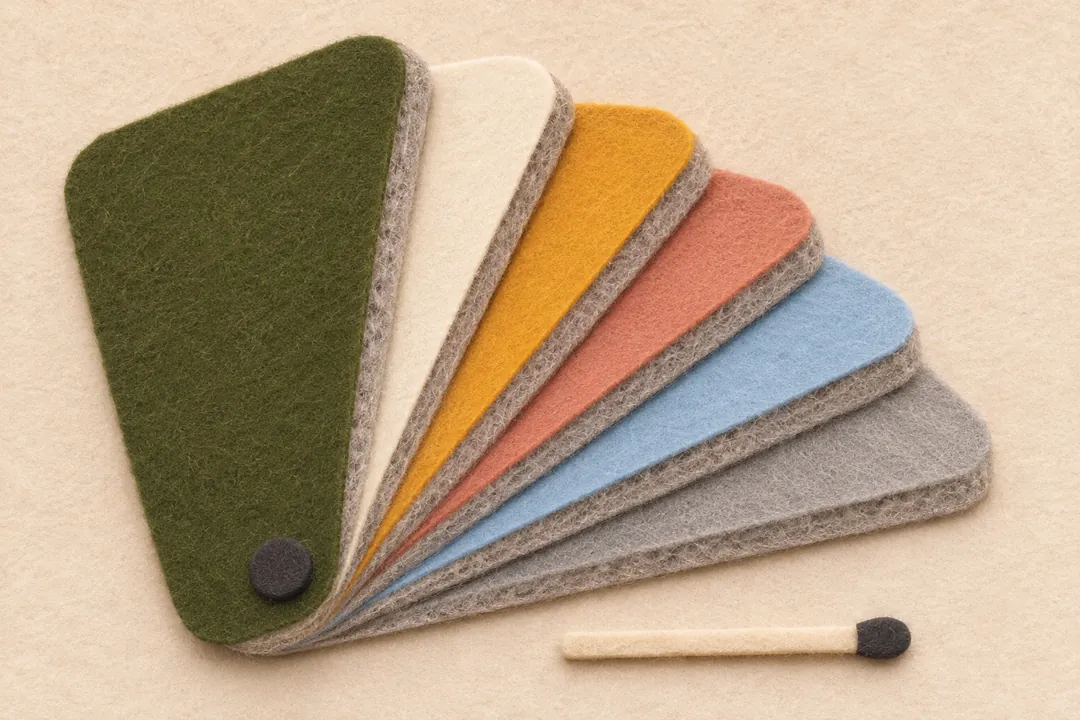
- Cores
- Mineral wool, fiberglass or PET felt
- Absorption data
- ASTM C423 reports published by material makers
- Fire data
- ASTM E84 indexes read against IBC classes
- Our own tests
- Not yet done; we name the reports we rely on
An acoustic panel is a simple object: an absorptive core, a face that lets sound through, and a way to hold it on a wall or ceiling. What separates one panel from another is mostly in the paperwork: how the core was tested for absorption and fire, in what mounting, to which edition of which standard, and whether that test covered the panel as it is actually built. One point before anything else: Fibson has not yet tested its finished panels. Every absorption and fire figure we use comes from the core or fabric maker’s published report, and your proposal names each one.
How our panels are built
Frame and edges. Fabric-wrapped wall panels and ceiling clouds have a frame or hardened edge that keeps them square, gives the fabric something to stretch over and gives the hardware something to grip.
Core. The core does the absorbing. We plan with three types:
- Mineral wool or fiberglass board, dense and rigid.
- PET felt, polyester felt that often contains recycled content. Recycled-content figures come only from the felt maker’s documents.
Absorption depends on the core’s thickness and density and on any air gap behind it. Thin panels absorb mostly mid and high frequencies; bass needs depth, which the air gap calculator helps you think through.
Acoustically transparent fabric. Sound has to pass through the face to reach the core, so the fabric must be open enough to let it through. A tightly woven or coated fabric reflects sound before the core can absorb it. On printed art panels the image is printed on such a fabric, and the fire report has to cover the printed fabric, not just the plain cloth.
Wood slats on felt. On wood slat panels the absorption comes from the felt between the slats and any cavity behind. The wood finish needs its own fire data, and only the tested combination of slat and backer can be described with that data.
Felt alone. Felt panels, tiles and shapes are PET felt without a separate face, so the same thickness rule applies.
How to read an absorption test report
ASTM C423 measures sound absorption in a reverberation room from the rate at which sound decays, and it is the method behind NRC and SAA figures. ASTM lists C423-23e1 as the active edition; a report should state the edition it used. ISO 354 is the comparable international method. When you read a report, check:
- The mounting. ASTM E795 sets out how specimens are mounted for C423 testing, and the mounting changes the result. A panel laid directly on the test surface (Type A) and the same panel with an air space behind it give different numbers. A ceiling cloud should be judged on data from a suspended mounting.
- The frequency table. Coefficients by band tell you far more than a single number. A panel can be excellent at 2,000 Hz and weak at 250 Hz.
- NRC. The average of the coefficients at 250, 500, 1,000 and 2,000 Hz, rounded to the nearest 0.05.
- SAA. The average of the one-third octave coefficients from 200 to 2,500 Hz, rounded to the nearest 0.01. Because of the different rounding, check which one a data sheet is quoting.
- Coefficients above 1.00. These are not errors. C423 notes that diffraction at the specimen’s edges can push coefficients past unity. ISO 11654, which gives the European single number (alpha-w), caps its practical coefficients at 1.00.
- The caveat. C423 itself says its coefficients “should be used with caution” in real rooms, which are larger than the test specimen and rarely have an even sound field.
Baffles and other objects are better described by absorption per unit, in sabins, than by a coefficient. The NRC calculator works out NRC and SAA from the coefficients in a report.
Fire: surface burning and interior finish
The test. ASTM E84 is a comparative surface burning test for materials used on walls and ceilings. A specimen about 24 ft long and 20 in wide is mounted in the ceiling position of a test tunnel, and the report gives a flame spread index and a smoke-developed index. ASTM lists E84-26a as the active edition.
The classes. The International Building Code (803.1.2) groups those results into classes:
| Class | Flame spread index | Smoke-developed index |
|---|---|---|
| A | 0 to 25 | 0 to 450 |
| B | 26 to 75 | 0 to 450 |
| C | 76 to 200 | 0 to 450 |
The code also treats materials that meet the NFPA 286 acceptance criteria as complying with Class A (803.1.1).
Panels are interior finish. IBC 806.2 says paneling applied “for decoration, acoustical correction” or similar purposes is interior finish and must comply with Section 803. The class required depends on the occupancy, where the material goes (exits, corridors or rooms) and whether the building is sprinklered (Table 803.13). In the 2021 model text, as published in the Seattle Building Code, rooms in Groups B, E, M and R-1 call for Class C, and rooms in assembly Groups A-1 and A-2 call for Class C when sprinklered and Class B when not, with exceptions in the table’s footnotes. Which edition and amendments apply to your building is for the local building official to decide.
The assembly caveat. E84 warns that supporting materials on the underside of a specimen can lower its flame spread index, and that results “do not necessarily relate” to the material without that support. A core’s rating does not automatically carry over to a finished panel with fabric, adhesive and a frame. We state a class for a panel only when the report covers the assembly as built. You will not see us call a panel Class A on the strength of a core rating alone.
Staying on the wall. IBC 803.14 requires interior finish to be fastened so it will not readily come loose at room temperatures of 200°F for at least 30 minutes. That is one reason the plan specifies how each panel is fastened, not only where it goes.
Emissions and PFAS documents
VOC emissions. The California Department of Public Health publishes the Standard Method for testing emissions from building materials, which grew out of the 2004 Section 01350 standard. Version 1.3, published in June 2026, supersedes version 1.2 (2017). It lowers the threshold for 1,4-dichlorobenzene and adds criteria for 1-bromopropane, ethylene glycol monobutyl ether and trimethylbenzenes, all effective January 1, 2027. When a supplier sends an emissions report, check which version it was tested to.
PFAS. California’s AB 1817 restricts regulated PFAS in textile articles, a term that includes furnishings and upholstery. The threshold is 100 ppm total organic fluorine from January 1, 2025, dropping to 50 ppm from January 1, 2027. Whether a particular acoustic fabric is a “textile article” is a legal question we do not answer for you. We ask every fabric supplier for a PFAS statement and list it.
We do not summarize any of this as “non-toxic” or “eco-friendly”, and we claim no product certifications. We list the supplier documents a LEED or WELL consultant may ask for, with their dates.
What your proposal lists
For each material in your plan, the proposal names:
- Core: maker, product, thickness and density; the ASTM C423 report with edition, mounting type, lab, report number and date; the ASTM E84 report with its indexes and exactly what was tested.
- Fabric: maker and product; its E84 report; its PFAS statement.
- Wood or other facings: their own fire data.
- Emissions reports, with the method version and date.
- The class your room requires from the code notes in the plan, and whether each report covers the assembly as built.
Each absorption figure is written in this form:
This plan uses absorption data published by [core maker] for [product, thickness, density], tested to ASTM C423 [edition] in [mounting type] by [lab], report [number, date]. Fibson has not yet tested its finished panels. Your proposal lists every report we relied on. Installed results vary with room shape, furnishings, occupancy and mounting.
If you are comparing suppliers, the acoustic panel spec checklist lists the questions to ask and the documents to request from anyone, including us.
Send us the room
Room size, a few photos and what happens in the space. We reply with questions or an outline of the plan.